Even a great cafe cannot survive a bad lease
At P&R we operate two cafes in two different states. Over the years we have signed and renewed dozens of cafe leases. We also hear about lease concerns from hundreds of cafe owners. In my view, education around leases is a key success factor for cafes. A bad lease typically means a cafe that struggles or closes its doors. Cafes and restaurants are currently closing at nearly double the national rate.
The problem is that in the lease space the landlords hold all the information and most of the power. Cafes don't know how much the cafe next door is paying or the appropriate benchmarks to compare their lease with. 91% of cafe and restaurant businesses are small, with fewer than 20 staff. In recent times, the gap between landlords' view of rental capacity and what cafes can sustain, or what benchmarks show is fair, has widened. This gap can only be solved through more transparent data sharing and fixing some of the power imbalance through national minimum standards.
The importance of this issue to the success of cafes is clear. That is the reason we made a submission to Treasury as part of the Harmonisation of retail tenancies and related commercial leasing consultation.
Short on time? Our checklist for cafe owners is at the end.
What the Treasury consultation is about
Treasury is asking how to make retail lease rules work the same way across Australia. The rules differ between the eight states and territories. The same cafe faces different rules on disclosure, turnover, outgoings, security and exit depending on the state.
The Productivity Commission flagged similar issues in 2008, but follow-through was partial.
There are two potential options under consideration:
- Option A: a single national law (would likely need states to refer powers)
- Option B: a national minimum baseline that states can exceed
Our recommendation is Option B. There are 27 questions, which can be found in the consultation paper for a deeper read.
Submissions closed 13th October.
Our six recommendations
We made six recommendations. The public part of our submission can be viewed here.
1. Reciprocal turnover data
2. National lease dataset
3. National turnover definition
4. Rent disclosure
5. Security cap and release
6. Option B baseline
The section below briefly explains each recommendation and the reason behind it.
Reciprocal turnover data
We want any landlord that collects your sales data to share category-level sales and occupancy data for the centre with you, before you sign and every six months after that. Today you report your sales every month and get nothing back while the landlord sees every tenant’s numbers. Singapore already requires landlords that collect sales data for turnover rent to share it by trade category before signing and every six months. Its code became binding for qualifying leases signed from 1 February 2024.
National lease dataset
Key lease terms should be lodged from the disclosure statement and published in aggregate, as a first step towards a public register of the rents tenants actually pay. You can’t negotiate well without knowing what comparable sites pay once incentives are considered. Treasury’s consultation paper notes that Australia lacks a comprehensive national register or consistent public dataset of lease terms. Ireland already has a public Commercial Leases Register.
National turnover definition
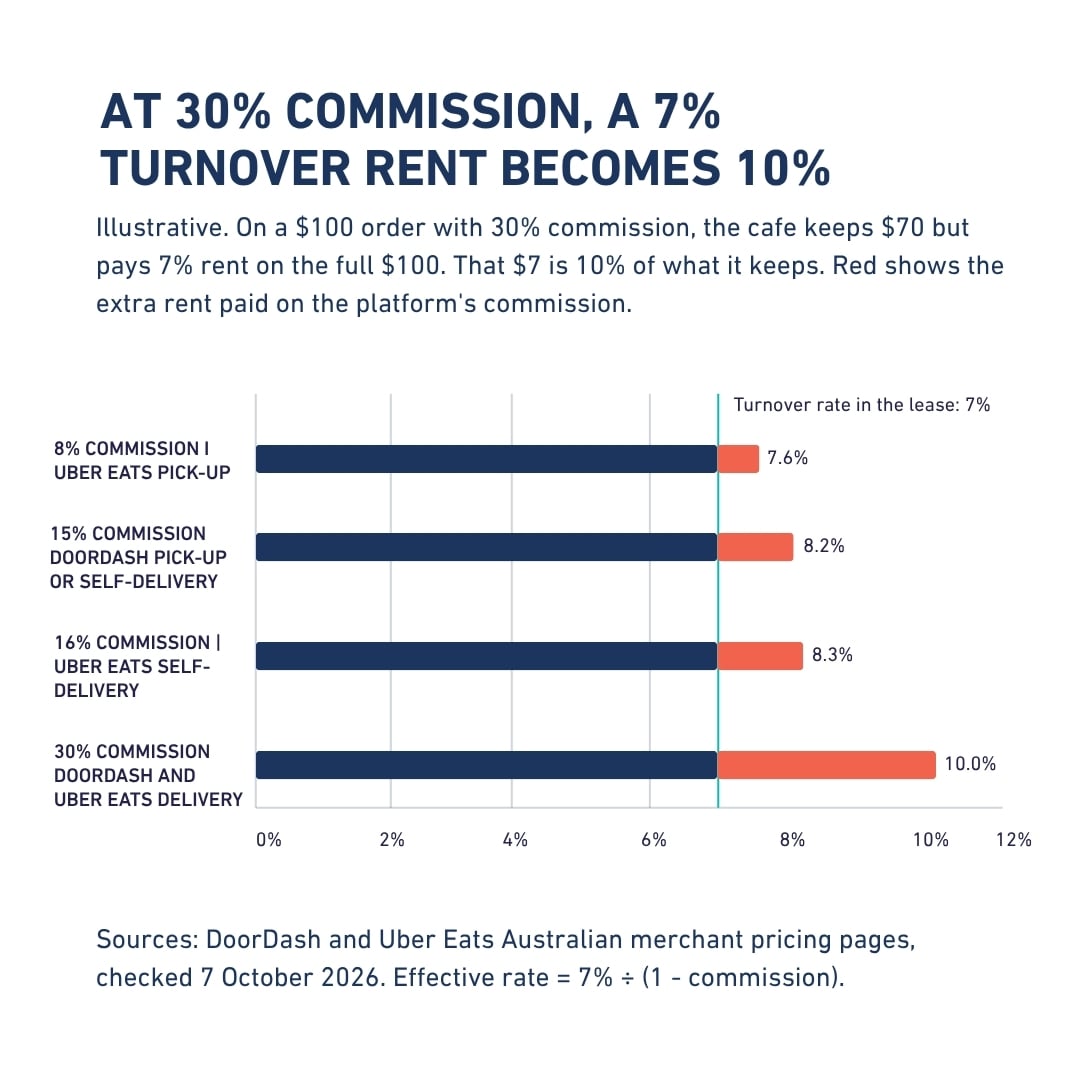
Turnover should be defined nationally with deliverymplatform orders counted at the amount the cafe receives instead of menu prices. Otherwise you pay turnover rent on the platform’s commission. At a 7% turnover rate and 30% commission, the rent comes to 10% of what you actually receive.
Rent disclosure
The disclosure statement should show the net effective rent, the minimum rent for every year of the term, the ATO rent-to-turnover benchmark for your type of business and, where turnover rent applies, the agreed breakpoint against the natural breakpoint (base rent divided by the turnover rate). Net effective rent is the average you pay once rent free months and fit out contributions are removed. In the example below, year 1 gross rent is 19% above net effective rent and fixed 4% increases take gross rent to $163,780 by year 5.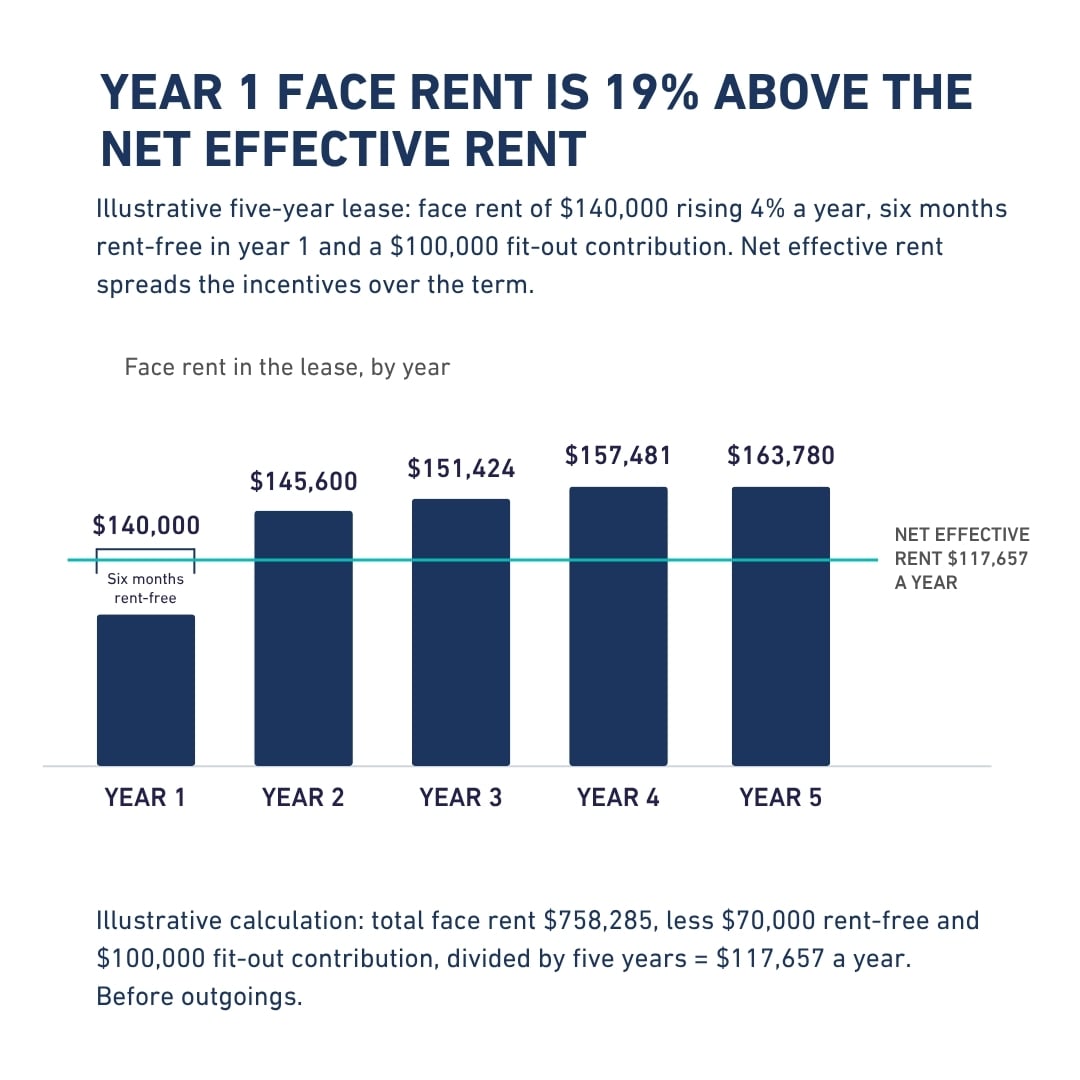
Security cap and release
We recommend a cap on security in any form, including bank guarantees, of three months’ rent, a set period for its return, and release of the outgoing tenant and guarantor when a lease is assigned with proper disclosure. Every month of security is working capital you can’t use, and a personal guarantee puts your own assets at risk. Our submission found that only South Australia, the ACT and Tasmania cap cash bonds or deposits, at three months’ rent, and that no state or territory expressly caps bank guarantees. Queensland, Western Australia and the Northern Territory set no period for returning security.
Option B baseline
We support Option B: a national minimum baseline introduced in three stages, with each state and territory publishing where it differs from the baseline and a review after three years. The quick fixes come first: the turnover definition, rent disclosure, and the return and release rules for security. Reciprocal data and the security cap follow 12 months later, and the national lease dataset follows within three years. Most states already have similar rules to build on.
What cafe owners should know
As cafe owners, you can change almost anything in your business but you often cannot change your lease. Learning more about leases and benchmarks is one of the highest-return investments of time and money you can make.
Below is a quick checklist to help you.
- Know your rent-to-turnover ratio. Compare it with the ATO benchmark for your turnover (chart below). The ATO range is 6% to 10% for cafes turning over more than $600,000 and 8% to 17% for smaller cafes, but our view is that anything over 10% is too much.
- Get the rent for every year of the term. Work out net effective rent: total rent, less incentives, divided by the number of years. Take rental increases into account.
- With turnover rent, find the natural breakpoint: base rent divided by the turnover rate. A breakpoint below it means you pay turnover rent on sales that your base rent already covers.
- Read the sales definition. Check whether delivery orders count at menu value or at the amount you receive.
- Check the security (bank guarantee) asked for against your state’s rules, and ask when and how you get it back. No state or territory expressly caps bank guarantees, so it pays to negotiate.
- Avoid or cap personal guarantees, and ask to be released if you assign the lease.
- Get the disclosure statement at least seven days before you sign (the minimum in most states), and check that it matches the lease.
Talk to your state’s small business commissioner (or equivalent) before a dispute escalates.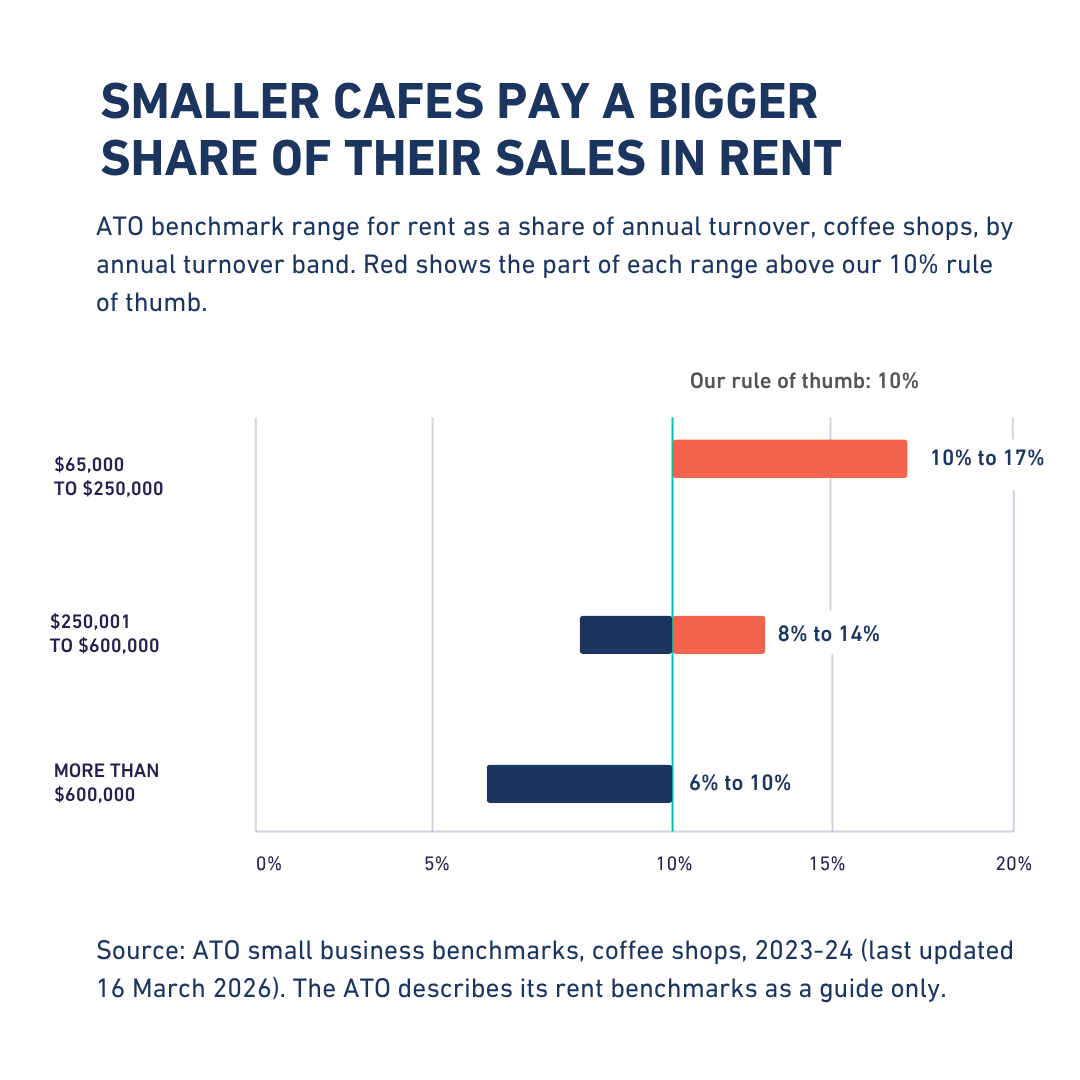
ATO coffee shop benchmarks, 2023-24
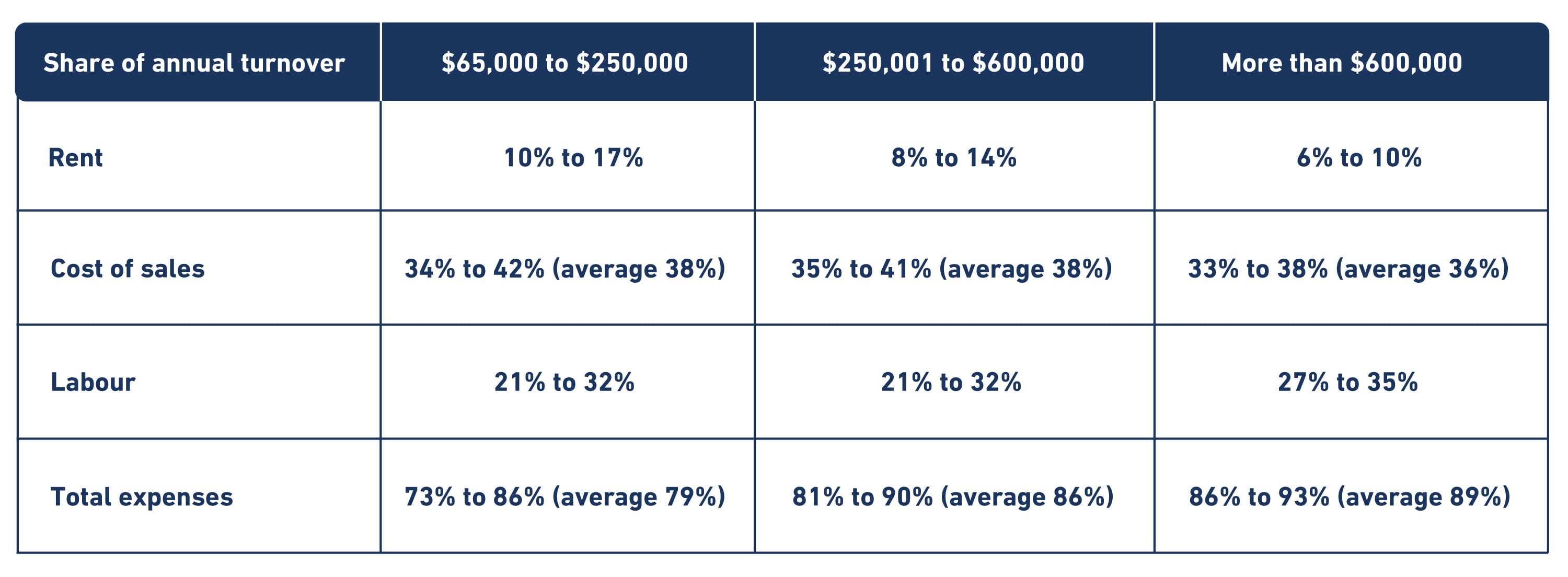
Source: ATO small business benchmarks, coffee shops, 2023-24, last updated 16 March 2026. The ATO says the labour and rent benchmarks are a guide only.
IBISWorld estimated the cafe and coffee shop industry’s revenue at $15.9 billion in 2025-26, across about 28,000 businesses, and names thin margins as its main pain point.
Further reading
For more information, read our blog on What cafe owners need to know about commercial leases.
If you have a lease experience you would like to share, we would love to hear it.
This article is general information, not legal or financial advice. Benchmarks and platform fees were checked on 7 October 2026.